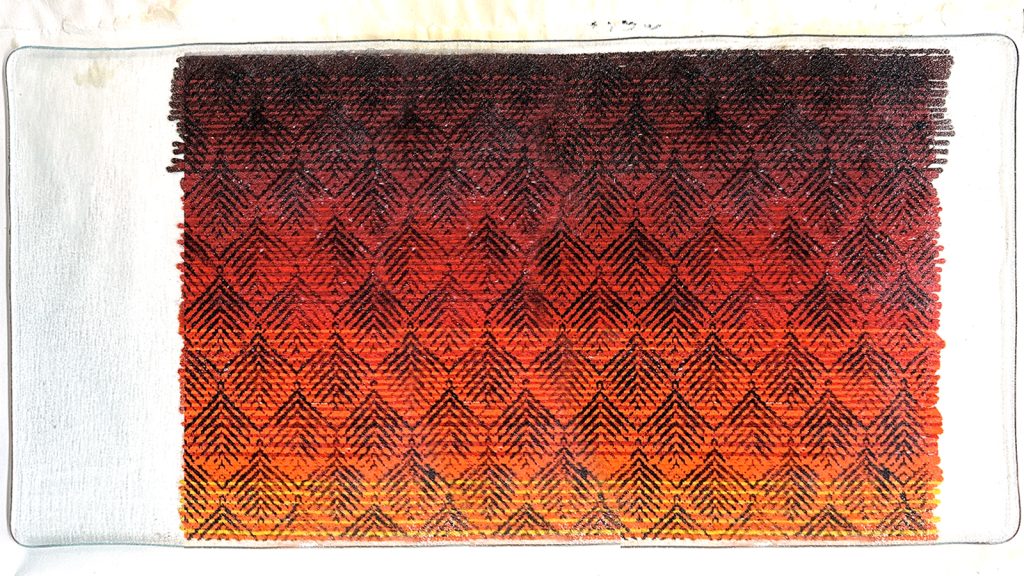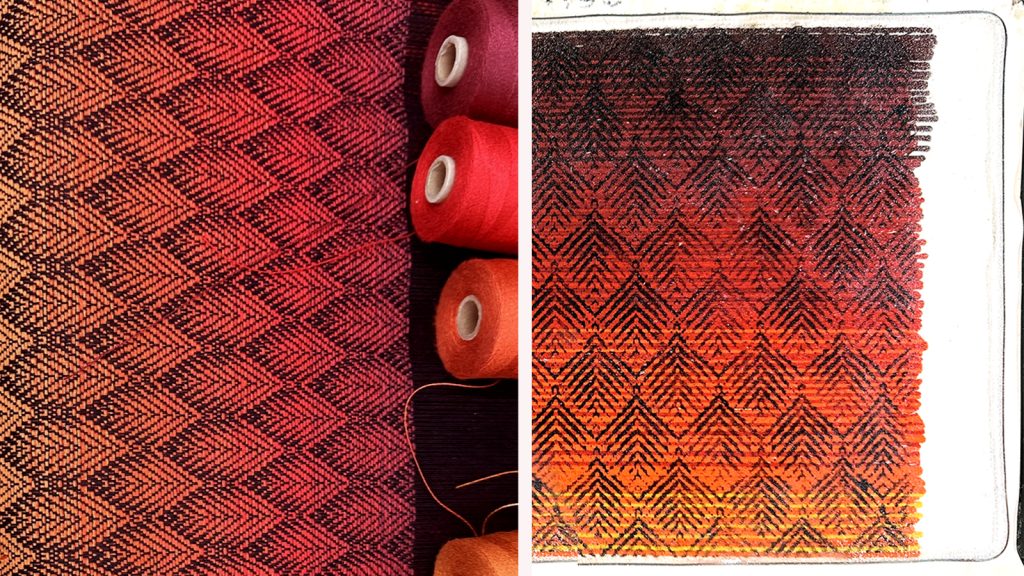
Weaving fibre was one of my first loves in craft. I had poor ergonomics and developed chronic, long-term repetitive use injury in my arm that cost me the use of my right hand for more than five years—I spent most of a decade in physiotherapy and had multiple surgeries as a result. Finding my way back to the loom now feels inherently a part of the phoenix story I am weaving in threads of glass and fiber.
In order to bend glass threads (stringers) In such a way that they can be threaded onto a glass warp and create my feather twill, I have conceived of a jig that combines methods used in torch working glass, weaving, and wire bending with metal punch cards that serve a very similar function to punch cards in a jacquard loom. While I work through this process, I am concurrently weaving on the compu-dobby loom in the weaving studio rendering the same feather pattern in fibre. This is the first time I have allowed myself to return to working with fibre since an injury to my arm two decades ago. Starting with phoenix feathers feels cathartic. While I sat at the loom for the first time in over twenty years, throwing the shuttle back and forth, my fingers deftly catching the floating selvedge threads, my hands carrying knowledge of the impact of tension on the yarn and its impact on the pattern—I reflected on how the vast majority of the cells in my body had been replaced multiple times over since the last time I executed this task, that on a cellular level I was mostly not in the same body and yet my body still carried the knowledge of how to weave. As I began to see the feathers emerge in my pattern I snapped a photo to send to my mom, who is also a weaver, and thought about the generations of artists in our bloodline, and the multitude of ways that my cells have been conditioned for this—the many stories written in my DNA that carry the knowledge and wisdom and skill of making.
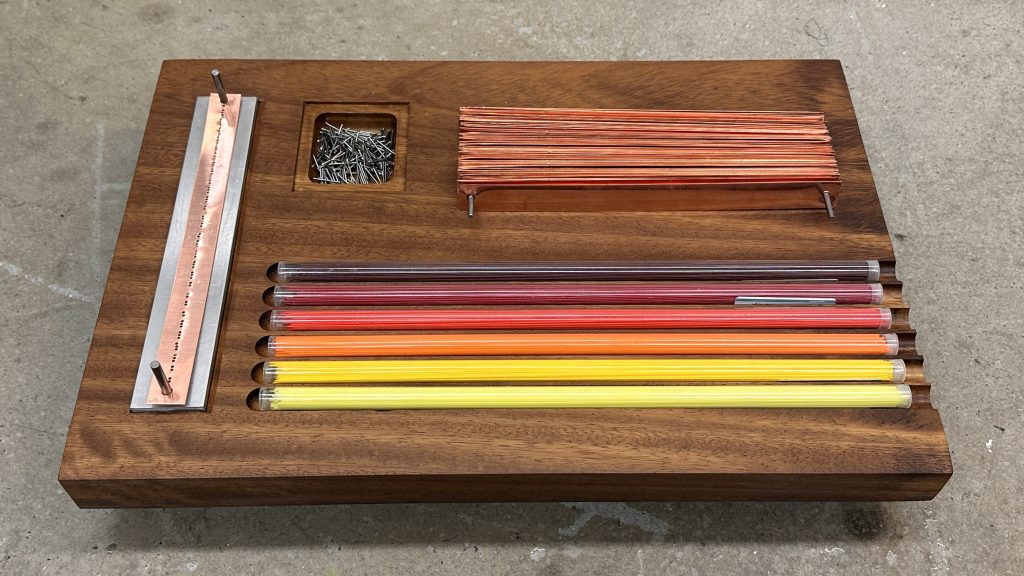
I scaled my loom based on commercially available stringers of glass, which come in 43cm lengths. I accounted for about 30% uptake when the threads are bent into their woven shape, and set my loom to be about 30cm wide. With a plan to weave 1mm diameter stringers, I drilled a line of 1.5mm holes set 1mm apart in a 5cm x 30 cm x1.3 cm block of aluminum. My theory was that this would give the weft a .25mm tolerance to each side of the warp threads, which both keeps them close enough to provide structure and integrity to the pattern, and allows for enough movement of the warp threads that there shouldn’t be undue amounts of friction or stress while assembling.
My feather pattern has a 50 thread repeat, so I cut 50 strips of copper, drilled registration holes at each end, and then transferred my pattern one row at a time to each strip. To do this, I placed the copper strips under the aluminum block, dropped pins in the holes that correspond with each pattern row, and used a hammer to press the pins into the copper. I then used a drill press to drill 2mm holes where the pins had left dents in the copper.
These “punch cards” would allow me to quickly determine each weft pattern, the holes they revealed allowing me to quickly drop pins into place. After dropping the sequence of pins, I planned to lay the appropriate colored stringer along the length of the row of pins. Starting from one end, I would use a small butane pin torch to soften the stringer, aiming for the gap between pins, and then using a small hooked tool, push the softened stringer between the pattern pins. I planned to quickly move the torch to the next gap, press the glass into place, and work my way down the length of the loom. Once I bent the entire stringer, I would lift it off the bending jig and onto a standing warp of glass stringers. When placed onto the warp in sequence, the bent threads would create the feather pattern. Once the pattern was completed, I would fuse the woven glass in the kiln onto a sheet of hand-blown sheet glass.
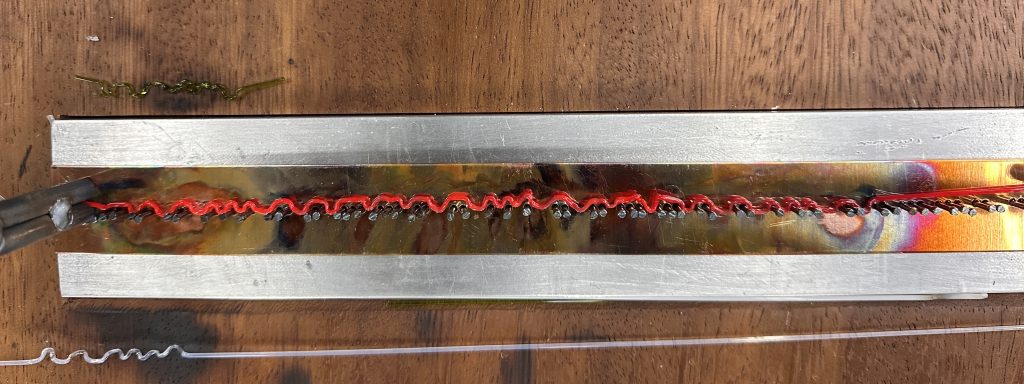
Or so I thought, and so I tried by every manner and means that I could devise to push, pull, or will the glass stringers into their required shapes. Unfortunately, glass stringers do not simply bend when heat is applied. Glass wants to be 6mm thick, which means that adding heat to 1mm stringers causes them to ball up, the heat induced liquid state does not provide adequate strength or resistance to be accurately pulled or pushed into an evenly curved weft thread. Prior to investing countless hours into drilling the punch cards, I did a test run to make sure that I could bend the stringers. I made two assumptions—one, that it would get easier as I got more practice, and two, that my stack of three weft threads was not in fact the maximum I could force onto the warp (or that as I improved my technique this would cease to be true).
I admitted defeat with the beautiful jig, and charted a new course. Rather than bending glass weft threads, I decided to try carving my warp threads into two sheets of glass, one for lifts, the other for drops, and fusing them with a layer of stringers laid in as weft in between.
At first I tried hand carving the warp pattern, using a dremel with a diamond grinding bit, which gave proof of concept but was still incredibly labor intensive, so I kept looking for a better way.
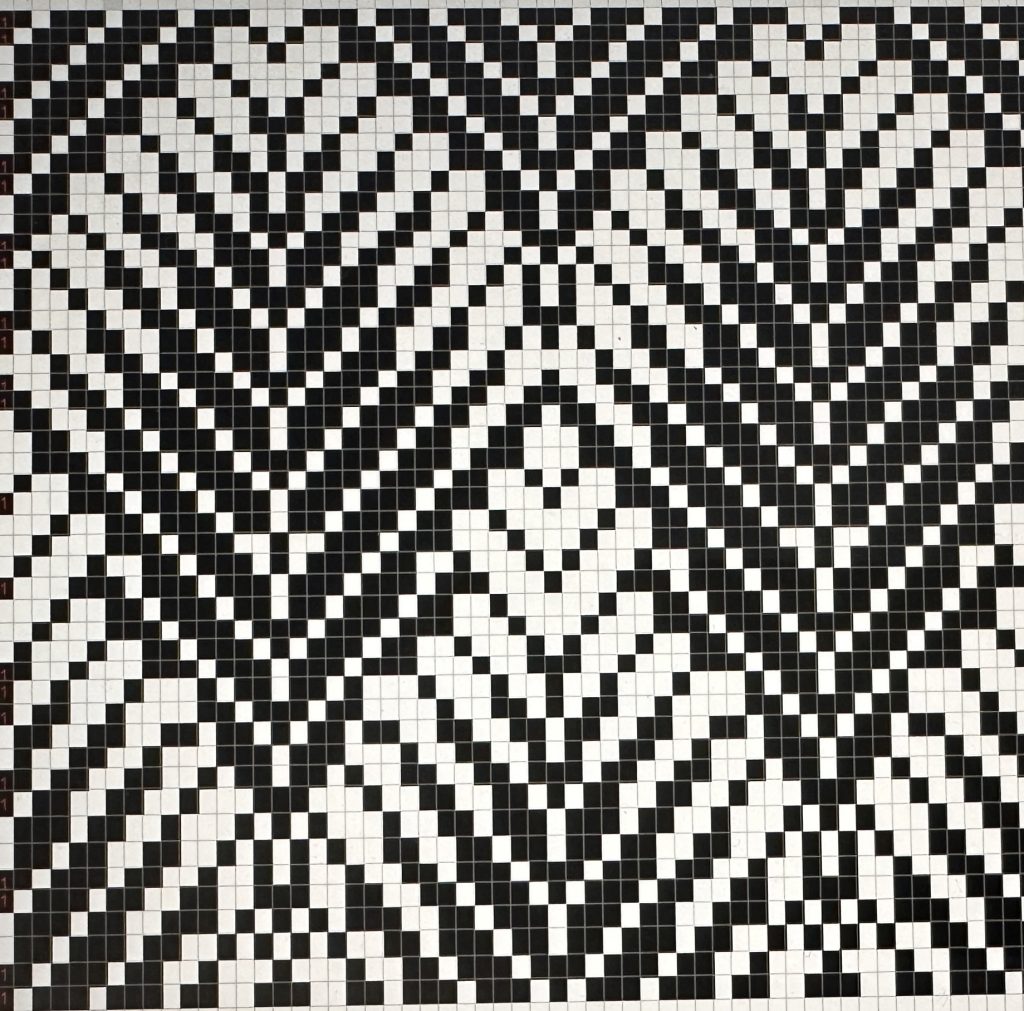
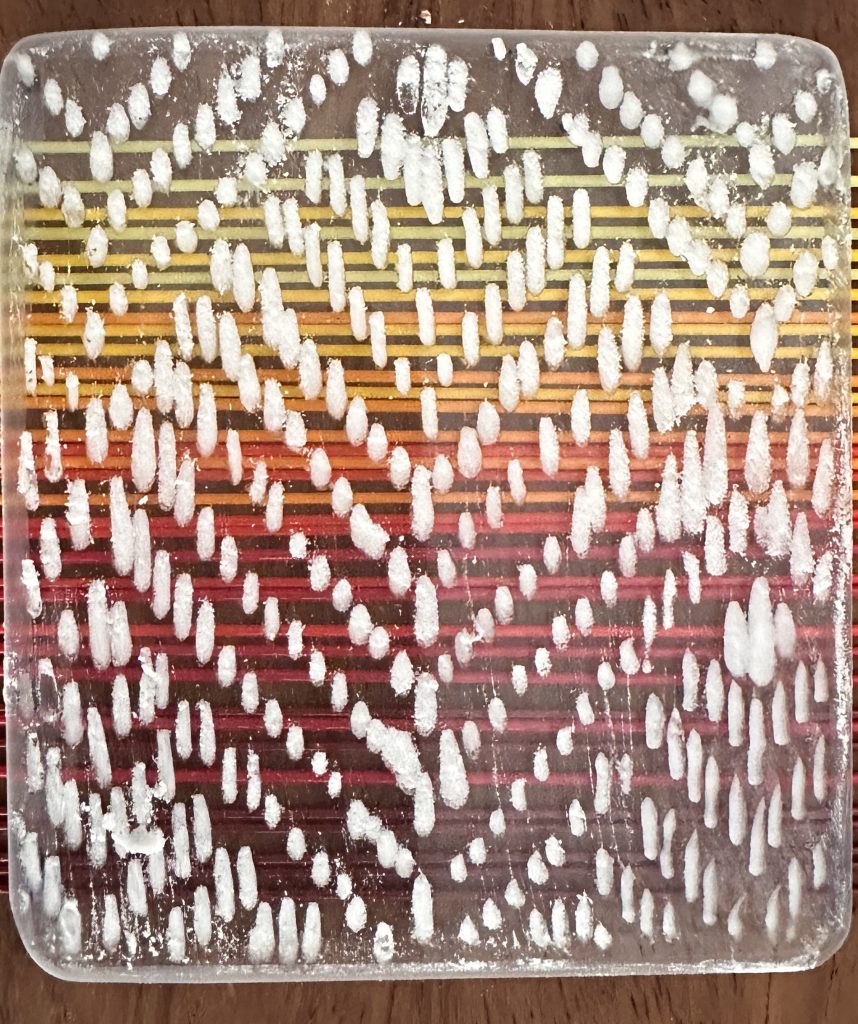
I ended up ordering UltraVinyl 10 mil photoresist film from Ikonics imaging, which has allowed me to sandblast the warp threads over 1mm deep into 5mm thick oceanside clear sheet glass. With the pattern etched this deeply, I was able to deposit the powdered black glass for the warp threads specifically and exclusively into the pattern.
Creating woven glass by sand carving warp threads into sheet glass, filling the carved areas with powdered glass and fusing was far more successful than attempting to bend weft threads on my jig.